
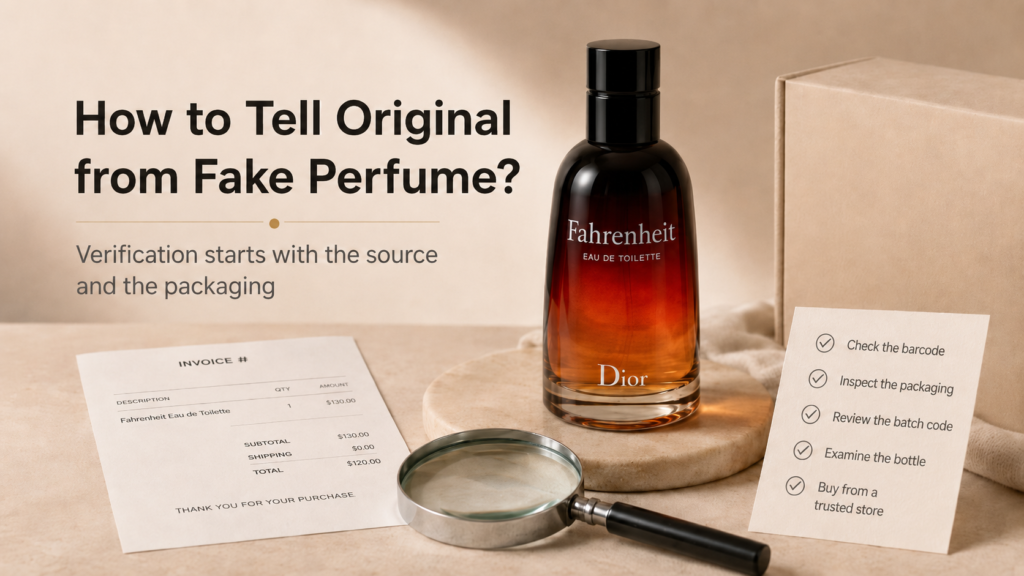
There is no single sign that proves a perfume is authentic across every brand. The strongest verification starts with a trusted seller, traceable supply chain, invoice and clear policies, then matching the exact edition name, concentration, size and market, followed by the brand’s official verification tool when one exists. Barcodes, batch codes, cellophane and print quality are supporting indicators that can be copied, and longevity or projection do not prove authenticity.
What Is the Difference Between Original, Fake, Inspired and Tester Perfume?
- Original perfume: a product that comes through an authorized production and distribution chain and matches the stated edition and market.
- Fake or counterfeit perfume: a product that uses a brand name or appearance in a way designed to make the buyer believe it is the original product.
- Inspired perfume: a product sold under a different brand that openly presents a scent direction similar to another fragrance. Similarity alone does not make it counterfeit if it does not impersonate the other brand or packaging.
- Tester: a term commonly used for display or trial stock. Its box or cap may differ by brand and market. The word Tester alone does not prove authenticity, and different packaging alone does not prove a fake.
Evidence Hierarchy for Checking Perfume Authenticity
| Evidence Level | Indicator | What It Supports | What It Does Not Prove |
|---|---|---|---|
| Strong | Purchase from an official channel or documented seller with invoice and order record | Provides a traceable purchase path and clear complaint route | Does not eliminate human error or a one-off shipment problem |
| Strong when available | Verification tool on the brand’s official domain | Checks the code according to that brand’s own system | Does not apply to brands without the same system, and some codes can be copied |
| Moderate | Matching edition, concentration, size, market and official images | Can reveal a mismatch or packaging that does not belong to the edition | Does not rule out a visually sophisticated counterfeit |
| Supporting | Printing, bottle, atomizer, cellophane and batch code | May reveal defects or inconsistencies worth escalating | Can be copied, and genuine packaging may differ between batches and markets |
| Weak on its own | Price, liquid colour, bubbles or longevity | May raise a question that deserves further checking | Does not prove authenticity or counterfeiting by itself |
Before Buying: How Do You Reduce Risk?
- Check the store identity: clear legal or trading name, contact methods, address or company information when available, and published policies.
- Review the invoice and order record: you should be able to prove the product, seller and date of purchase.
- Read the return policy before paying: especially because opened fragrance may not be returnable unless there is a confirmed issue.
- Check the complete edition name: brand, line, flanker, concentration, size and official audience.
- Judge the price in context: a very large discount deserves a question, but it does not prove a fake by itself; promotions, market differences and supply conditions can affect price.
- Ask for real photos when needed: especially of the code, bottle base and box when the item is high-value or packaging has changed.
- Make sure the seller remains contactable after delivery: avoid sellers that disappear after payment or have no clear complaint process.
After Delivery: Document the Product Before Opening It
Before removing cellophane or using the fragrance, photograph the shipment and box from all sides and keep the shipping label and invoice. Match the product name, concentration and size to your order, and look for damage, previous opening or obvious mismatch.
This matters because the King Store return and refund policy requires fragrances and care products to remain unopened, unused and in original packaging, except where there is a confirmed problem from the store side.
Does a Barcode Prove a Perfume Is Original?
No. A barcode identifies a commercial item or package in a coding system, and the same number can be copied and printed on a counterfeit product. Codes may also differ between sizes, markets or packaging versions of the same fragrance.
Use a barcode to help match the basic product identity, not as an authenticity certificate. If scanning it opens a general result or a web search, that does not prove the bottle left the brand’s factory.
What Is the Purpose of a Batch Code?
A batch code helps the manufacturer trace a production batch. It may appear on the box and bottle in formats that vary by brand and batch. A matching code can be a supporting indicator, while a missing or inconsistent code may justify questions, but it does not prove authenticity on its own because the code can be copied.
Unofficial websites that estimate production dates from batch codes can help interpret codes for some brands, but they are not issuing authorities and do not authenticate the product. A result showing a plausible date does not prove that the bottle itself is genuine.
Is a QR Code Stronger Evidence?
A QR code is useful when it is part of an official brand verification system, leads to the correct official domain and returns a result tied to a unique code or scan history. Lattafa, for example, asks customers to find the holographic security label, scan the code and confirm that the link is verify.lattafa.com, and it warns about codes scanned many times because they may have been copied.
Do not generalize that system. The absence of a QR code does not mean another brand’s perfume is fake, and a printed QR code is not enough if it opens a similar-looking domain or unofficial page. Read the domain carefully and do not enter personal information on a suspicious site.
How Do You Inspect the Box and Bottle?
Compare the product with official brand images for the same edition and market. Check:
- Spelling of the brand, edition, concentration and size.
- Position of logos, typography, colours and raised details.
- Print quality of ingredients, warnings and company information.
- Consistency of bottle, cap and atomizer, and any leakage or damage.
- Batch code, its position and format compared with reliable references for the relevant batch or market.
- Importer labels or legitimate market-specific regulatory differences.
These are indicators, not universal rules. Some genuine products come without cellophane, and typography, cap or box design may change after an official redesign. Tester and Gift Set packaging can also differ from standard retail packaging.
Are Liquid Colour, Bubbles or the Atomizer Decisive Tests?
No. Perfume colour can change gradually because of age, light, heat or the nature of its materials, while bubbles and trapped air may vary according to how the bottle was shaken or how the atomizer is designed. The so-called Bubble Test is not a standardized authenticity test.
Leaks, sediment or a major scent change may point to poor storage or deterioration or another product problem, but they do not by themselves tell you whether the fragrance is genuine or counterfeit. A genuine perfume can be damaged by bad storage, and a fake can look visually convincing.
Does Weak Longevity or a Different Smell Mean the Perfume Is Fake?
Not necessarily. Performance changes with dosage, climate, skin, olfactory adaptation, official reformulations, bottle age and storage conditions. You may also be comparing a different concentration, release year or market without realizing it.
Do not use a number of hours as an authenticity test. If the scent is radically different or there is another issue, collect several types of evidence: packaging photos, order number, official verification code, exact edition name, then contact the seller or brand.
Why Can Two Genuine Bottles of the Same Perfume Look Different?
- Official redesign of the box or logo.
- Different market, legal labels or importer information.
- Different size, concentration, Gift Set or Tester format.
- Change of manufacturer or packaging-component supplier.
- Official reformulation or natural colour change over time.
- An older and newer batch being sold at the same time.
Compare the edition, batch and time period, not two random internet photos.
How to Use Lattafa’s Verification Example Correctly
- Find the brand’s security label on the package.
- Scan the code with your camera.
- Confirm the domain is verify.lattafa.com, not a similar-looking address.
- Read the result and scan count.
- If the result is Invalid or the scan count is unusually high and you did not repeatedly scan it yourself, document the screen and contact the seller and brand.
These steps apply to Lattafa products that use this system. They do not mean every brand must use QR verification or that any QR outside the official system is trustworthy.
What Should You Do If You Suspect a Problem?
- Stop using the product if it causes irritation or its safety is in doubt.
- Do not throw away the box, invoice or shipping label.
- Photograph the issue clearly: box, bottle, base, code and the specific mismatch.
- Record what you are comparing against: official product-page link or a reliable image from the same market.
- Contact the store: provide the order number and an objective description, not only “longevity is weak so it is fake.”
- Use brand support: especially when there is an official verification or brand-protection system.
- Escalate to the relevant authority: when there is documented suspected fraud or an unjustified refusal to address the complaint.
Short Checklist Before Payment and After Delivery
| Stage | Check |
|---|---|
| Before payment | Known store, clear contact, return policy, invoice, full edition name, price that makes sense in context |
| On delivery | Photograph shipment, match size and concentration, check damage and do not open before documenting |
| Official verification | Use only the correct brand domain when an official system exists |
| Visual inspection | Compare the exact edition, market and batch instead of applying one packaging rule to every brand |
| If suspicious | Collect evidence and contact the seller before continued use or discarding the packaging |
How to Use Authenticity Evidence Before Opening an Order
When receiving a fragrance from King Store, do not make spraying it or comparing longevity your first test. Start with product identity: full edition name, concentration, size, box and bottle appearance, then keep clear photos before removing packaging. If there is a material mismatch with the product page or order, documentation before use is stronger evidence than trying to prove authenticity from a barcode or batch code alone.
You can use the perfume category to compare the full edition name, concentration and size shown on product pages before treating a difference as evidence of a problem.
Then review the store’s returns policy and contact support before using the item when the mismatch is significant. This does not turn any single indicator into an “authenticity test,” but it preserves evidence and makes the condition easier to review.
Official Sources
- Lattafa: official product verification guidance
- INTERPOL: shopping safely and avoiding counterfeit goods
- EUIPO: intellectual-property enforcement and counterfeit seizure data
Frequently Asked Questions
Does a barcode prove that a perfume is original?
No. Barcodes can be copied. Use them to match the item and size, then rely on the purchase source and an official brand verification system when available.
Is a matching Batch Code conclusive proof?
No. It is a supporting indicator that helps trace a batch, but it can be copied. Unofficial batch-date websites also do not issue authenticity certificates.
Does missing cellophane mean the perfume is fake?
No. Some products, Testers or Gift Sets can use different packaging, and brands can redesign packaging. Compare the exact edition and market with an official source.
Does weak longevity mean the perfume is counterfeit?
No. Performance is affected by weather, dosage, skin, olfactory adaptation, reformulation and storage. Use independent evidence to check authenticity.
Does every QR Code prove authenticity?
No. It is useful only when it leads to the brand’s official domain and a known verification system. Fake or copied QR codes can be printed.