
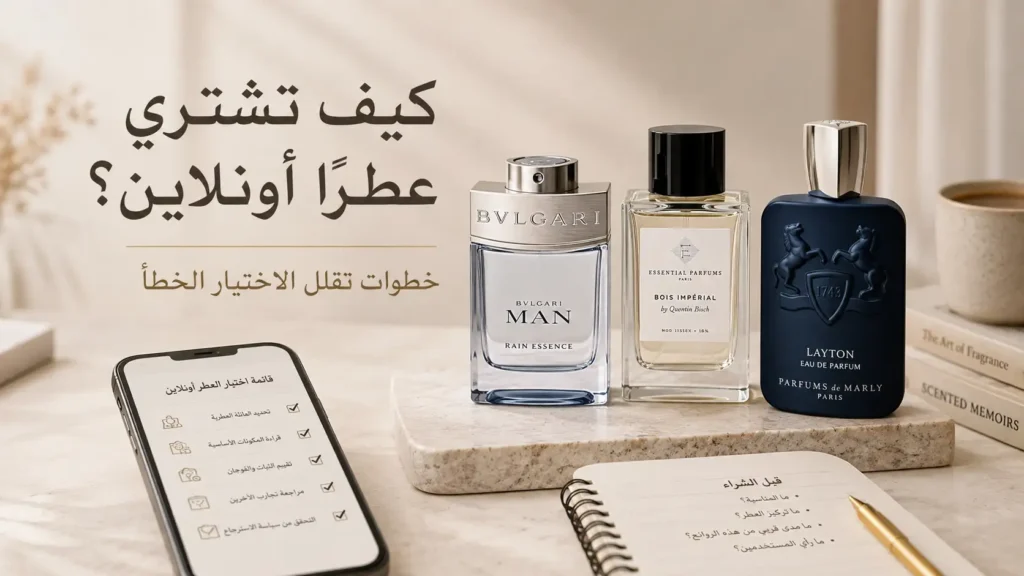
Buying perfume online without smelling it first is always a probability-based decision. No note list, rating or “best blind buys” list can guarantee that a fragrance will suit your skin. But you can reduce the risk significantly when you start from fragrances you already know, define the scent character and intended use, verify the exact edition, compare the official description with multiple impressions and review the return policy before opening the product.
What Can You Know Before Buying, and What Can You Not Know?
| You Can Estimate Before Ordering | You Cannot Guarantee Without Testing |
|---|---|
| The broad family and scent character: citrus, floral, woody, amber or green | Whether you will enjoy the final balance on your own skin |
| The exact edition name, concentration, size and official notes | Exact longevity and projection in your own conditions |
| Whether the brand positions the fragrance for work or evening use | Whether a specific note will trigger a headache or personal aversion |
| Repeated review patterns such as sweetness or sharpness | That your experience will match reviewers’ experiences |
| Store policy, delivery terms and available product condition | That an opened product can be returned simply because you dislike it |
The goal is not to turn a description into a smelling experience. It is to eliminate unsuitable options and build a short list whose risk level you understand.
Start with Three Fragrances You Already Know
Before searching for a new perfume, write down two or three fragrances you have worn or tested clearly, then record what you liked and disliked about each one. Do not stop at “I like fresh perfume.” Describe the experience more precisely:
- Did you like bright citrus, or more of an aquatic or green effect?
- Do you enjoy vanilla sweetness, or does it feel heavy?
- Do you prefer clean musk or dry woods?
- Did a sharp opening bother you before the fragrance improved, or did you dislike the final dry-down?
- Do you want controlled presence for work or a more noticeable scent for occasions?
These observations are more useful than a note list alone because they connect the decision to a real experience you already have.
Turn Your Taste into Scent Character and Use, Not One Note
You may enjoy a perfume containing bergamot, but bergamot appears in hundreds of very different formulas. Do not search only for “a perfume with bergamot.” Look for a complete character close to what you already like: clean citrus-woody, soft fruity-floral, aromatic green or sweet amber.
Also define the setting. A fragrance for an air-conditioned office and crowded transport may differ from one for an open-air evening event. When the purchase is a gift, risk rises because you are choosing on someone else’s behalf; knowing a fragrance the recipient already wears or choosing a smaller size therefore becomes even more useful.
Read Notes Without Imagining Them Literally
Fragrance notes are descriptive language, not a chemical recipe. Apple, leather or sea breeze do not mean the perfume will literally smell like a real apple, a piece of leather or ocean air. An Accord may also be built from multiple materials.
Read the list this way:
- Start with the family and overall character stated by the brand.
- Notice elements that repeat the same direction: several citrus notes, woods, spices or florals.
- Treat an unfamiliar note as a question that needs more description, not as a final judgment.
- Check whether the brand published a pyramid or only key notes.
- Do not assume two perfumes sharing three notes will smell similar.
Use the guide to fragrance notes and the scent pyramid to distinguish Note, Ingredient and Accord.
Confirm the Exact Edition Before Reading Any Review
One of the most common buying mistakes is reading reviews for one edition and ordering another with a similar name. Confirm:
- The brand and full product name.
- EDT, EDP, Parfum, Elixir or Le Parfum.
- Whether it is the original or a flanker such as Intense, Absolu or X.
- The size, because some Gift Sets and Testers differ in presentation and packaging.
- The release year or bottle design when a redesign has occurred.
For example, Y Le Parfum is not interchangeable with every fragrance in the Y line, and Layton has its own identity within Parfums de Marly. Compare the official page for the exact edition, not just the line name.
How Should You Use Reviews?
Reviews are useful when you look for repeated patterns rather than a final verdict. Read different source types: the official brand page for identity, a reliable store for specifications, editorial reviews for development and comparison, and user experiences for recurring objections.
| Source Type | What It Helps With | What It Does Not Prove |
|---|---|---|
| Official brand page | Full name, concentration, story and official notes | That you will enjoy the scent or get a fixed level of performance |
| Store page | Size, condition, policies and ordering details | That every marketing phrase is an objective measurement |
| Specialist reviewer | Development and comparisons in detailed language | That their taste and conditions represent everyone |
| User reviews | Repeated reports of sweetness, sharpness or other common reactions | Authenticity or one fixed number of hours for everyone |
Look for recurring descriptions such as “sweeter than expected” or “a sharp opening followed by a dry woody phase.” Be cautious with a review that does not identify the edition, climate or number of sprays, and do not use star ratings alone to make the decision.
Blind-Buy Risk Matrix
| Risk Level | Situation | Best Next Step |
|---|---|---|
| Relatively low | You have tested the exact edition or finished a sample | Verify the seller and size, then order |
| Medium | You know a close fragrance from the line or brand and understand the scent character and notes you dislike | Read several sources and choose a conservative size if available |
| High | You do not know the brand, the composition is experimental, or it contains notes you often dislike | Look for a sample or trustworthy decant, or ask for help narrowing the options |
| Very high | A gift for someone whose taste you do not know, or an expensive full bottle without testing | Choose a fragrance they already wear, a gift card or another lower-risk option |
There is no fragrance that is universally “safe for blind buying.” The accurate description is that one option may carry lower risk for one particular person because of prior knowledge.
Examples of the Decision Process, Not Guarantee Lists
Bvlgari Man Rain Essence
Bvlgari publishes a clear pyramid including green tea, orange, lotus, musk, mineral amber and guaiac wood. It may make sense for someone who already knows they enjoy a green, aquatic and woody direction, but it is not a guarantee for someone who dislikes mineral musk or does not know that style. Review the Man Rain Essence product page after matching the description with the official source.
Y Le Parfum
The official description highlights pine, geranium, patchouli and fir balsam. These suggest a relatively darker aromatic-woody direction, not simply a “stronger” version of every other Y fragrance. Someone who likes the line should not assume they will automatically like every edition.
Parfums de Marly Layton
The official pyramid combines apple, bergamot and cardamom, then lavender, violet and geranium, with vanilla, praline and woods in the base. Someone who does not enjoy sweetness or warm spice should raise the risk level rather than buying on reputation alone.
Bois Impérial
The brand describes the composition as a continuous story involving Thai basil, Timut pepper, vetiver, modern woods, patchouli and Ambrofix. It should not be reduced to “a fresh woody perfume everyone likes.” This example shows why the store description should be checked against the official source when the brand does not publish a formal pyramid.
Choose Bottle Size According to Risk
When a perfume is completely new to you, a smaller size reduces the potential loss if it is available from a trusted source. Do not buy a large bottle only because the price per millilitre is lower when you are uncertain about the smell. If you have already tested and regularly wear the fragrance, a larger size may make more sense.
Be cautious with decants or samples from unknown sources. Reducing bottle size does not solve authenticity or poor-storage risk. Evaluate the seller, packaging and proof of purchase just as you would for any other product.
Review the Return Policy Before Opening the Package
The King Store exchange and return policy explains eligible products, excluded cases and required procedures. Review the version in force when you order before opening or using the package, and do not rely on returns simply because the smell does not suit your taste.
When the parcel arrives:
- Photograph the parcel and box before removing the packaging.
- Match the name, concentration and size with your order.
- Check for damage, previous opening or the wrong product.
- Do not open the product if you find a mismatch and want the store to resolve it.
- Keep the invoice and shipping label and contact the store immediately through the published channels.
If you open the perfume and then discover only that the scent does not suit your taste, do not assume it can be returned. Refer to the policy that applied when you ordered. This is something to resolve before purchase, not after use.
What About Delivery Inside Egypt?
Review the published shipping policy for current estimated timing, fees and conditions. If the perfume is a gift needed on a specific date, order with a time buffer and verify the phone number and address.
Quick Decision Tree Before You Click “Place Order”
- Have you tested the exact edition? If yes, move on to seller and size verification.
- Do you know two fragrances you like and understand their scent directions? If no, start there before searching.
- Are the name, concentration and flanker clear? If no, do not compare reviews yet.
- Is there a note or style you usually dislike? If yes, increase the risk level and look for a sample.
- Have you read the official page and at least two independent sources? If no, keep researching.
- Does the return policy still make sense given that the item should remain unopened? If no, do not treat returns as your safety net.
- Do the price and bottle size match your level of uncertainty? If no, choose a lower-risk option.
Pre-Order Checklist
- You wrote down two or three fragrances you know and what you liked about them.
- You defined the intended setting and desired scent character.
- You confirmed the full name, concentration, size and edition.
- You read the notes as directional information rather than a guarantee.
- You checked the official page and varied reviews.
- You separated personal opinion from official product information.
- You assessed the risk and chose an appropriate bottle size.
- You reviewed return, shipping and contact policies.
- You will not open the package before checking the order and its condition.
Turn Blind Buying into an Elimination Process First
Before choosing a fragrance online from King Store, write down three things you clearly do not want, such as dense sweetness, obvious smoke or sharp citrus. Use the product description and note structure to eliminate fragrances that clearly lean in those directions before searching for a “best choice.”
If several options remain, compare scent character, use case, concentration and size rather than relying on one rating number. For example, Bvlgari Man Rain Essence can be read as a fresh watery-woody option, not as a guaranteed “summer perfume” simply because of its name or category.
Official and Reference Sources
- Bvlgari Man Rain Essence — official page
- YSL Beauty Y Le Parfum — official page
- Parfums de Marly Layton — official page
- Essential Parfums Bois Impérial — official page
- The Perfume Society: test on paper and then skin before buying
Frequently Asked Questions
Does sharing the same notes mean two perfumes are similar?
No. Proportions, surrounding materials, construction and blending method differ, and the same note can play a completely different role in each fragrance.
Are user ratings enough to choose a perfume?
No. Use them to identify repeated impressions, then verify the exact edition and official page. A rating remains one person’s experience under different conditions.
Are there perfumes guaranteed to be safe blind buys?
No fragrance is guaranteed to appeal to everyone. Risk only becomes lower when you know the edition, your taste and the scent direction clearly.
Can I return a perfume if I opened it and did not like it?
The exchange and return policy in force at the time of your order defines eligible cases and exclusions. Review it before opening the product and contact the store when there is a confirmed error or issue.
How do I choose perfume as a gift?
Start with a fragrance the recipient already uses or a scent character you know they like. If you do not know their taste, reduce risk with a smaller size or ask for a shortlist rather than making a random high-value choice.