
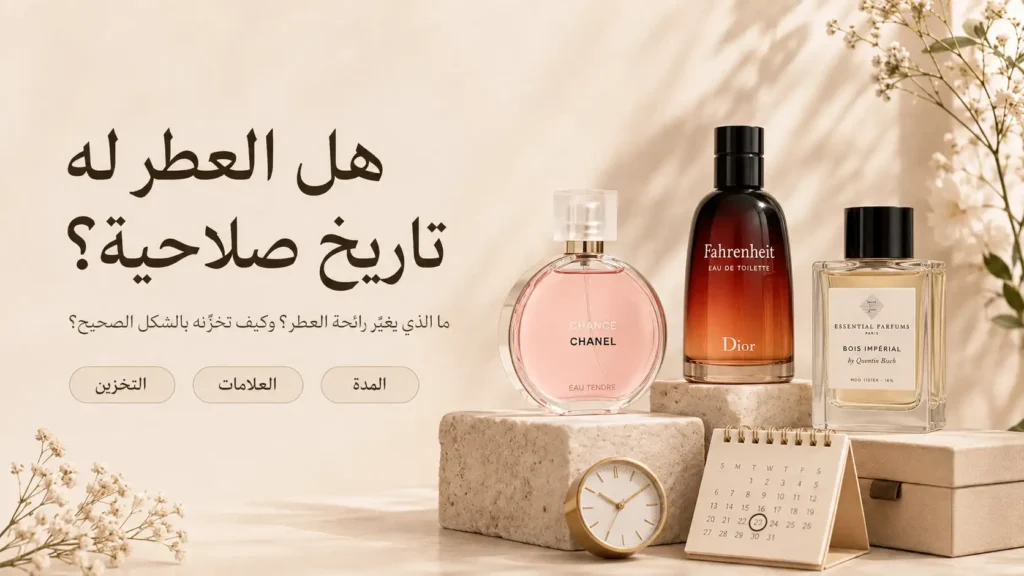
Yes, perfumes can change over time, but there is no rule saying every bottle expires after three or five years. A fragrance’s usable life depends on the formula, seal quality, the amount of air inside the bottle and storage conditions. Check the smell, appearance, atomizer and leakage together. A Batch Code identifies a production batch and is not automatically an expiry date, and a PAO symbol does not necessarily appear on every perfume.
What Does Perfume Shelf Life Mean?
Shelf life is the period during which a product is expected to maintain its characteristics and remain suitable for use under intended storage conditions. The U.S. Food and Drug Administration explains that cosmetic shelf life varies by product type, use and storage, and that heat, light, air and moisture can cause changes in colour, texture or smell.
A tightly sealed alcohol-based perfume behaves differently from a cream touched with fingers, so do not transfer shelf-life rules from other cosmetic products to perfume. Two different fragrances may also change at different rates.
Does Every Perfume Have a Printed Expiry Date?
Not necessarily. In the United States, general cosmetic rules do not require an expiry date on every cosmetic product, while the manufacturer remains responsible for safety. In the European Union, durability information depends on the expected product life; products with a minimum durability longer than 30 months may use a period-after-opening indication where that concept is relevant.
So the absence of a clear date does not mean a bottle is counterfeit, and having a date does not mean the perfume will suddenly become unusable the next day if it remains stable. Follow the brand’s instructions and assess the actual condition.
Production Date vs Batch Code vs PAO
| Information | What It Means | What It Does Not Prove |
|---|---|---|
| Production date | The date the product was manufactured when disclosed by the company or officially confirmed | A fixed spoilage date under every storage condition |
| Batch Code | A reference used to identify the manufacturing batch for traceability and quality control | That it is an expiry date or conclusive proof of authenticity |
| PAO | An open-jar symbol followed by a suggested period of use after opening | That it appears on every perfume or that the bottle has been stored correctly |
| Best Before / Expiration | A durability or expiry date when assigned by the manufacturer or required for the relevant product category | A substitute for checking the smell, appearance and package condition |
How Can You Tell That a Perfume Has Changed?
Do not rely on one sign. Compare the current condition with what you know about the bottle when it was in good condition and review these indicators:
- Smell: a sharp, sour or unusual odour, or a clear loss of the fragrance’s main character.
- Appearance: new cloudiness, unusual sediment or separation that was not previously present.
- Colour: a clear and rapid colour change can justify inspection, but colour alone does not prove spoilage; some formulas naturally darken over time.
- Atomizer: blockage, irregular spray or a different smell coming from the tube.
- Package: leakage, noticeable evaporation, damaged closure or contamination.
- Reaction: unusual irritation after use means you should stop using the product and seek medical advice when appropriate.
Does a Colour Change Mean the Perfume Has Gone Bad?
No. Colour can change because of oxidation, colourants or certain materials while the fragrance may still smell acceptable. But colour change combined with an abnormal smell, cloudiness or leakage is more meaningful than colour alone. Do not use internet photos as a final standard because lighting, packaging and edition may differ.
How Should You Store Perfume?
- Keep it in a dark place or inside its box away from direct sunlight.
- Choose a stable temperature instead of repeatedly moving between heat and cold.
- Do not leave it in a car, beside a window or near a heat-producing appliance.
- Keep the cap or atomizer securely closed and store the bottle upright.
- Avoid the bathroom because of humidity and repeated temperature changes.
- Do not transfer the liquid into an unsuitable container unless necessary and only with clean, tightly sealed tools.
- Record the date you opened the bottle if you want to track its age practically.
Is the Refrigerator the Best Place for Perfume?
Not as a general rule. The best environment is stable, moderate and dark. A refrigerator can create repeated temperature changes when the bottle is taken out and returned, and humidity or surrounding odours can become an issue if the bottle is not tightly sealed. Use refrigeration only when the manufacturer recommends it for a specific product, or when your home conditions are extremely unstable and you can provide genuinely stable specialized storage.
Are the Bathroom or Dressing Table Suitable?
The bathroom is not ideal because of steam and temperature fluctuation. A dressing table can be suitable only when it is away from sunlight and heat. A box or drawer inside a stable room is usually safer than displaying the bottle in front of a window.
Opened vs Unopened Perfume
An unopened bottle has less exposure to air and use, but poor storage and extreme heat can still affect it. After opening, a small amount of air enters during use, and its effect increases as the liquid level drops. This does not mean the perfume will spoil immediately; it explains why two bottles of the same age can end up in different condition.
What Should You Do If You Are Unsure?
- Temporarily stop applying the perfume to skin.
- Test the smell on clean paper in a well-ventilated area.
- Compare it with the official description or a fresh sample of the same edition if possible.
- Photograph cloudiness, leakage or atomizer problems.
- Contact the store or brand with the edition name, Batch Code and photos.
- Discard the product if there is a clearly unacceptable smell, contamination or repeated irritation.
What Is the Relationship Between Shelf Life and Authenticity?
A genuine perfume can change when stored badly, and a counterfeit product can appear stable at first. So weak performance or colour change does not prove counterfeiting, and a Batch Code can be copied and is not enough by itself. Use the available perfumes and product pages for comparison, and review the source, invoice and package condition when in doubt. If performance is the only change, review the longevity, projection and sillage guide before linking it to deterioration.
A Practical Receive-and-Store Routine After Buying Perfume
- Document condition on arrival: keep a photo of the box and bottle if there is visible leakage or damage before use.
- Do not treat one small change as proof of deterioration: color variation alone is not enough, especially across time or different lighting.
- Choose a stable storage location: a cupboard or drawer away from direct sun, strong heat and high humidity is better than a windowsill or bathroom.
- Watch for a group of changes, not one sign: a persistent change in smell combined with a liquid or packaging issue is more informative than a generic age rule.
If you keep several bottles from the King Store perfume range, recording the opening date and storage location makes later comparisons more reliable than memory alone.
Trusted Sources
- FDA: cosmetic shelf life and expiry dating
- FDA: using cosmetics safely and signs of product problems
- EU Cosmetics Regulation: durability information and PAO
Frequently Asked Questions
Does every perfume expire after three years?
No. There is no single lifespan for every perfume. Formula, storage, closure and the amount of air inside the bottle all affect how it changes.
Is a Batch Code an expiry date?
No. It is a reference used to identify the manufacturing batch and can help establish a production date when an official source exists, but it is not automatically an expiry date or conclusive proof of authenticity.
Does colour change mean the perfume is damaged?
Not by itself. Check the smell, cloudiness, sediment, leakage and atomizer as well. Some fragrances naturally change colour over time.
Should perfume be stored in the refrigerator?
Not usually. A moderate, dark, dry and stable place is generally better. Do not use refrigeration as a universal rule unless the manufacturer gives specific guidance.
Can unopened perfume go bad?
It can change with time, heat or light, but it is less exposed to air and use than an opened bottle. Actual condition and storage history matter more than age alone.