
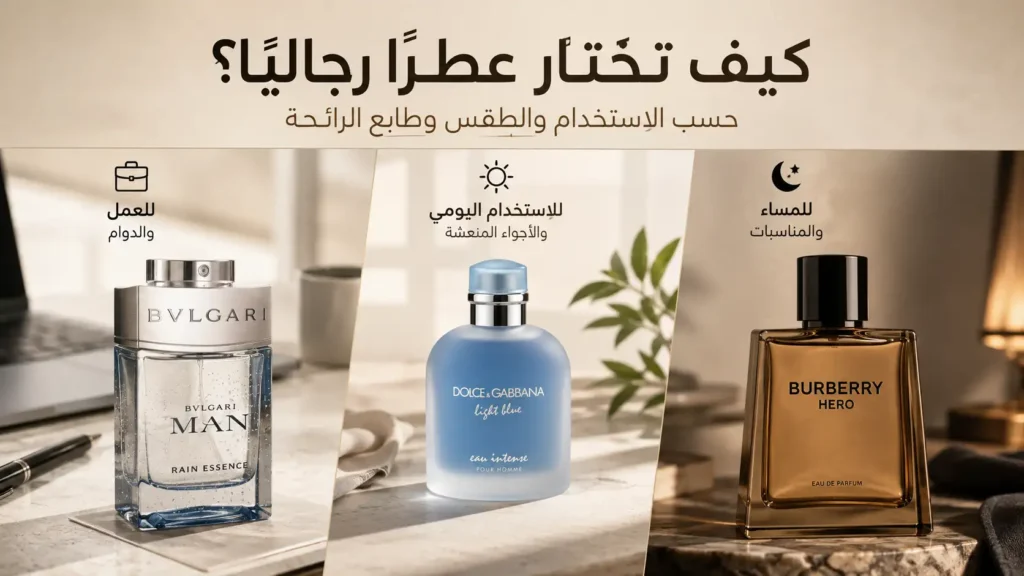
Do not start choosing a men’s fragrance by asking “What is the strongest perfume?” Start by asking where you will wear it, in what weather, and what level of presence is acceptable in that setting. Then choose the scent character you enjoy and confirm the exact edition and concentration. A fragrance that works well in an office may not be the best choice for an evening event, and a warm scent is not automatically better just because it feels denser.
Define the Use Before Looking at the Perfume Name
The setting changes what “suitable” means. In a shared office or a long meeting, the comfort of people around you is part of the decision. In open-air daily use, you may accept a clearer presence, while an evening occasion usually gives you more room for a warmer or richer style, provided dosage and personal space are still considered.
Break your need into four simple scenarios:
- Work and study: controlled presence, with a clean, calm woody or unobtrusive aromatic character.
- Daily use: a flexible fragrance that can move between different errands without being tied to one occasion.
- Going out and evening: you can explore a warmer, sweeter or spicier direction while controlling the number of sprays.
- Occasions: choose a fragrance that feels distinctive to you, not simply one with high projection.
Quick Table for Choosing a Men’s Fragrance by Scenario
| Scenario | What to Look For | Directions to Explore | What to Avoid |
|---|---|---|---|
| Closed office or meeting | Close aura and good control | Fresh woody, clean musk, calm aromatic | Overspraying or choosing a scent that fills the room |
| Daily use | Flexibility across more than one situation | Citrus woody, aquatic, green, modern fougère | Buying only because a fragrance is popular |
| Evening and social use | Warmth, depth or clearer presence | Woody amber, spicy, leather, balanced sweetness | Treating sweetness or power as a guarantee of appeal |
| Hot weather and transport | Clean feeling with measured dosage | Citrus, tea, fresh woods, aquatic notes | Using the same winter dosage in heat and humidity |
| Gift | Reduce risk and collect evidence about taste | A fragrance they already wear or a style they clearly prefer | Calling any perfume “safe for everyone” |
How to Choose a Fragrance for Work
At work, the priority is not the longest longevity or the highest projection. The priority is keeping the scent within a reasonable personal space. Offices vary: a crowded open-plan space is not the same as a private office, and some colleagues may be sensitive to fragrance. Start with a smaller dose and test it on a normal day before an important meeting.
Fresh woody or clean aromatic profiles can be useful starting points, but they are not rules that exclude every other family. A warm fragrance can work at the office if it is naturally quiet or applied lightly, while even a fresh fragrance can become distracting when oversprayed.
Bvlgari Man Rain Essence Eau de Parfum 100 ml is a useful example. Bvlgari officially describes it as Fresh Woody Musk, which makes it an educational example of how freshness can sit within a woody-musky structure, not a promise that it will suit every office or every wearer.
How to Choose a Fragrance for Daily Use
A successful daily fragrance is one you enjoy and can control, not simply one marketed as “versatile.” Ask yourself:
- Do I prefer clean and fresh, or warm and sweet?
- Do I spend most of my time indoors or outdoors?
- Do I want one morning application, or am I comfortable reapplying if needed?
- Can I tolerate a sweet or smoky dry-down for hours, or does it become tiring?
Do not force one bottle to do every job. You can have a quiet work option and a warmer evening option even if both belong to the woody family.
Men’s Fragrance for Evenings and Occasions
Evenings often allow richer styles: incense, benzoin, woods, spices or sweetness. But “richer” does not mean the fragrance should announce your arrival before you enter the room. Venue size, ventilation, clothing and weather all change the right dosage.
Bvlgari Man in Black is a useful example of a richer evening direction, with a warm spicy, leathery character supported by woods and resins that gives it more depth for occasions and cooler settings.
Burberry Hero Eau de Parfum is an example of a warm woody direction. Burberry’s official page mentions incense and benzoin over cedarwood and pine oils. Use it as an example to understand the style, then decide whether you actually enjoy warm woods and incense.
The Y line from Yves Saint Laurent also shows why you should confirm the full edition before relying on a description. The line includes several similarly named versions, and there is also a newer release called Y, The New Le Parfum that differs from the earlier edition. When reviewing Y Le Parfum available at King Store, match the bottle image, full name and notes to that exact edition instead of transferring the description of a newer release to an older product.
Choose the Overall Character Before a Single Note
A lemon note does not automatically make a fragrance fresh, and vanilla does not automatically make it dense and sweet. A note works inside a complete formula. It is more useful to read the overall scent character: fresh woody, amber fougère, spicy leather, citrus aromatic or warm gourmand.
Fresh, Citrus and Aquatic
These styles may suit people who enjoy a clear, clean opening and can be useful in heat or daytime use, but do not assume they are automatically weak or short-lived.
Woody and Aromatic
This is a broad area that can range from dry and clean to smoky and resinous. The word “woody” alone is not enough.
Amber, Sweet and Spicy
These styles can bring warmth and depth and are often used in evenings or milder and cooler weather, but they can still work during the day depending on the formula and dosage.
Floral and Styles Outside Traditional Masculine Marketing
Floral materials are not exclusive to women’s fragrance. Lavender, iris, rose and orange blossom have long appeared in perfumes marketed to men and may sit inside woody, leathery or fresh structures.
How Egypt’s Weather Affects the Choice
Heat can make a fragrance feel faster and more noticeable at first, while transport and crowded spaces increase the chance that a heavy dose becomes uncomfortable. In winter or air-conditioned settings you may prefer a warmer profile, but there is no list of families that is forbidden in summer or guaranteed in winter.
- In intense heat: test a smaller dose and observe what happens when you move from outdoors into air conditioning.
- In an air-conditioned office: do not compensate for the cool room by overspraying before you enter.
- On a summer evening: a warm fragrance can still work if you enjoy it and keep the application controlled.
- In winter: do not assume every dense perfume will perform well; test how it develops on your skin.
Should You Choose EDT, EDP or Parfum?
Do not use concentration as a shortcut for quality or strength. An EDT and EDP can use different formulas, and a Parfum may wear smoother and closer to the skin than an edition with a lighter concentration name. Check the official page for each release and compare scent and use, not only the abbreviation.
If you are deciding between two editions, review the perfume category and compare the full name, concentration, size and scent character. Do not rely on bottle shape alone; the same line may include Elixir, Le Parfum and Intense editions with different formulas.
Quick Decision Tree
- Where will you wear it most? Closed office, errands, going out or occasions?
- What level of presence do you want? Close and quiet, or noticeable at conversational distance?
- What scent character do you enjoy? Fresh, woody, warm, sweet, spicy or leathery?
- What is the weather and how do you move around? Heat, humidity, transport or air-conditioned spaces?
- Have you confirmed the exact edition? Full name, concentration, size and release year where similar versions exist.
- Have you tested it? Try paper first and then skin when possible, and wait for the dry-down before buying a full bottle.
Common Mistakes When Choosing a Men’s Fragrance
- Buying the highest-rated perfume without defining the use.
- Treating high projection as a quality signal.
- Linking specific notes to masculinity as a fixed rule.
- Choosing a gift based on age or appearance alone.
- Mixing up different editions from the same line.
- Judging from the first minute and ignoring the heart and dry-down.
- Copying someone else’s spray count despite a different setting and climate.
Build a Men’s Shortlist by Use Case, Not Fame
Instead of browsing dozens of names, choose one use case and compare three directions already available at King Store. For work or daytime, you might start with Bvlgari Man Rain Essence as a fresher direction, compare Burberry Hero EDP for warmer woods, and consider Bvlgari Man in Black when you want something darker and warmer.
This is not a ranking. It is a way to narrow the field. Once you know which direction fits you, browsing the men’s perfume category becomes more useful than choosing the most famous name.
Verification Sources
- Bvlgari Man Rain Essence — official page.
- Burberry Hero Eau de Parfum — official page.
- The Perfume Society — fragrance selection and testing guidance.
Frequently Asked Questions
What men’s fragrance is suitable for the office?
Look for a scent whose aura you can control and start with a smaller application at work. Fresh woody or clean musky styles can be useful starting points, but suitability depends on the formula and setting, not the family alone.
Is the strongest perfume better for occasions?
No. A distinctive fragrance is one that fits your taste and the setting while staying comfortable for people around you. Excessive strength in an enclosed venue can ruin the experience even when the scent itself is good.
Is a “blue fragrance” a safe choice for everyone?
“Blue” is a marketing description often used for fresh aromatic or woody styles. It is not one fragrance family and does not guarantee universal appeal.
How do I choose a men’s fragrance as a gift?
Start with a fragrance the recipient already wears or ask about a family they enjoy. The less you know about their taste, the greater the risk, and no fragrance is guaranteed for everyone.
Is EDP always better than EDT for men?
Not necessarily. The two editions may differ in scent structure as well as concentration. Compare the full names and official descriptions and test both when possible.