
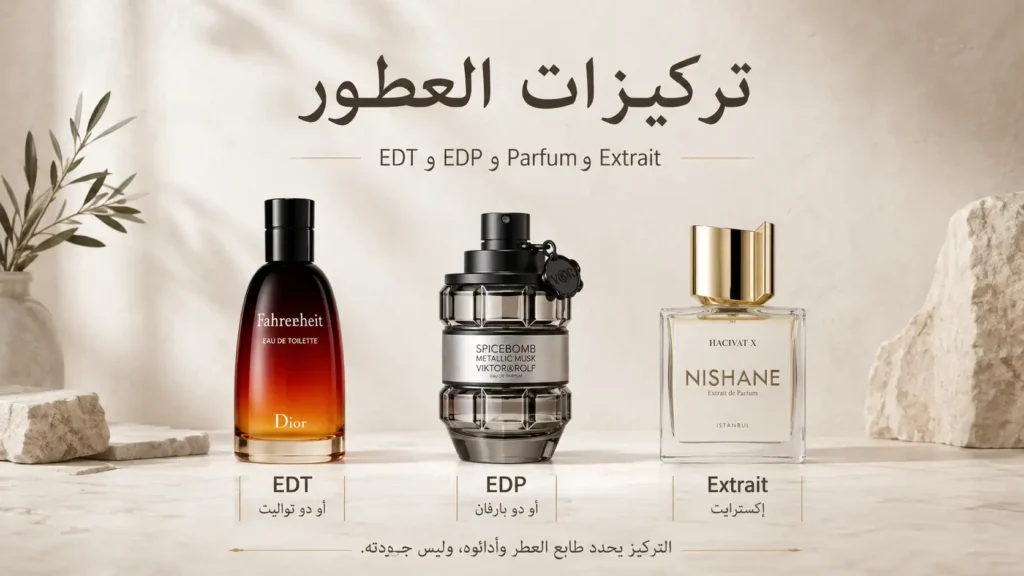
Perfume concentration alone does not tell you whether a fragrance is better, longer-lasting or more projecting. Terms such as EDT, EDP, Parfum and Extrait describe commonly used ranges for the amount of fragrance compound in a finished product, but they are not globally standardized quality grades. Start by understanding the exact edition, its formula and scent character, then use the concentration name as one part of the comparison rather than a final judgment on performance or smell.
What Does Perfume Concentration Mean?
Perfume concentration generally refers to the approximate proportion of fragrance compound in the finished liquid compared with alcohol, water and other functional ingredients. People often call this “the percentage of perfume oils,” but that is a simplification: the fragrance compound can contain natural materials, manufactured aroma materials and supporting solvents, not only natural oils.
French terms such as Eau de Toilette, Eau de Parfum and Parfum appear on bottles and help create an initial expectation, but they do not reveal the full formula, how its materials evaporate or how far it will project on your skin.
Perfume Concentrations in Order: Guidance Ranges, Not Fixed Laws
The International Fragrance Association explains that these terms are broad descriptions commonly used on labels rather than definitions fixed precisely by one global standard. The following ranges reflect common industry practice, not mandatory specifications for every brand or edition.
| Label | Indicative Fragrance-Compound Range | How to Use the Information | What It Does Not Guarantee |
|---|---|---|---|
| Splash / Aftershave | About 1–3% | Often indicates a lighter fragrance product intended for frequent use | It does not define scent quality or skin suitability |
| Eau de Cologne (EDC) | About 3–8% | Gives an initial expectation of a lighter style in many products | It does not mean every cologne smells alike or has equally short performance |
| Eau de Toilette (EDT) | About 5–15% | Helps identify the exact edition when one line has several versions | It does not automatically mean weaker or lower quality than EDP |
| Eau de Parfum (EDP) | About 10–20% | Often sits in a higher range than EDT, with possible overlap | It does not guarantee a fixed number of hours or stronger projection |
| Parfum / Extrait | About 15–40% | Commonly refers to a higher fragrance-compound range | It does not guarantee the smell is simply an identical, stronger EDP |
Primary source for the ranges: IFRA guidance on using the standards. IFRA notes that the ranges reflect industry practice rather than strict regulatory definitions.
Why Do Percentage Ranges Differ Between Charts?
You may find one source placing EDP at 10–20% and another starting at 15%. This does not necessarily mean one chart is completely right and the other wrong for every product. The labels themselves are not governed by one fixed global definition, and some ranges overlap.
Do not calculate the exact concentration of one bottle from a general chart unless the manufacturer publishes the figure. Use the chart to understand the direction, then return to the official edition name, brand description and information printed on the package.
Does Higher Concentration Mean Better Longevity or Projection?
The amount of fragrance compound can influence the wearing experience, but it is not the only factor. Performance also depends on formula structure, the volatility of individual materials, dosage, weather, skin, clothing and testing method.
One edition can remain close to skin for longer while another projects more clearly at first and then becomes quieter. This is why three different ideas need to be separated:
- Longevity: how long the scent remains detectable.
- Projection: how far the scent is noticeable around the wearer during a particular stage.
- Sillage: the scented trail left during movement and after passing.
There is no number of hours that applies to every wearer, and none of these metrics can be determined from the abbreviation EDP or EDT alone.
Do EDT, EDP and Parfum with the Same Name Smell the Same?
Not always. Editions may share a recognizable signature, but the brand can change the notes, their balance, and the structure of the opening, heart and base, or release a new version carrying the same main line name with a different character. Do not treat Parfum as the same bottle with simply more fragrance compound added.
The Fahrenheit line is a useful example. Dior describes Fahrenheit Eau de Toilette around mandarin, violet and a woody-leathery direction, while Fahrenheit Parfum highlights violet and leather with Bourbon vanilla. The line clearly shares an identity, but the formulas and experience are not simply one scale of strength.
At King Store you can review Dior Fahrenheit Eau de Toilette as an example of why the full edition name matters instead of relying on the word Fahrenheit alone.
What Do Intense, Elixir and Le Parfum Mean?
These are commercial names or names for editions within a fragrance line, not one standardized concentration ladder that applies to every brand. One brand may use Elixir for a formula that differs significantly in smell and construction, while another uses Intense or Le Parfum in a completely different way.
Read the full official name exactly as the brand writes it. Do not assume Elixir is always above Parfum, that Intense means one fixed percentage, or that Le Parfum always equals Extrait.
What Does 80% Vol Mean on a Perfume Bottle?
%Vol usually refers to the percentage of alcohol by volume in the liquid, not the percentage of fragrance compound. So 80% Vol does not mean the fragrance contains 80% perfume oils, and it cannot be used by itself to decide whether a product is EDT or EDP.
If the label is unclear, rely on the official concentration name and manufacturer information instead of trying to calculate fragrance concentration from the alcohol percentage.
How Do You Choose Between EDT, EDP and Parfum?
- Confirm the exact edition: write down the brand, line, concentration and size, and make sure you are not comparing a different flanker with the original.
- Compare the smell before performance: review the official notes and description for each edition because the scent character may change more than you expect.
- Define the type of presence you want: do you prefer a noticeable opening or something that stays closer to skin? Do not assume the answer from concentration alone.
- Test in the same way: compare on skin under similar conditions with a similar number of sprays and do not judge only from the first minutes on paper.
- Consider the setting: offices, public transport and enclosed spaces differ from open-air occasions; suitability matters more than always choosing “the strongest.”
- Review the package and official page: the complete commercial name matters more than any general chart, especially with Intense, Elixir and newer editions.
Examples of How to Read a Concentration Name
Viktor & Rolf Spicebomb Metallic Musk Eau de Parfum is an example of an edition with a clear sub-name inside the Spicebomb line. “Metallic Musk” is part of the exact edition identity, while EDP identifies the concentration category written officially. It should not be reduced to “the strongest Spicebomb” or compared with the original from the line name alone.
Fahrenheit Eau de Toilette is another example of a classic edition that must be distinguished from Fahrenheit Parfum. The existence of both names in the same line reinforces the need to compare the official description for each bottle rather than automatically choosing the edition with the apparently higher concentration label.
You can browse the perfume category and compare full names, concentrations, sizes and scent directions before moving to a purchase decision.
The best decision is to compare the exact edition: its official name, formula, scent direction and the way you plan to use it. Use the concentration abbreviation to narrow your options, then let the specific product information and real testing decide the comparison.
Frequently Asked Questions
What is the main difference between EDT and EDP?
The general difference is the fragrance-compound range used in the product, with EDP usually sitting in a higher range than EDT. But the ranges overlap and are not globally standardized, and the formula and smell of two editions with the same main name may differ.
Is EDP always better than EDT?
No. The better option depends on the smell you prefer, your use and the construction of each edition. You may prefer an EDT opening or projection, while the EDP character may suit someone else better; neither label is an absolute quality grade.
Does Parfum or Extrait project more?
Not necessarily. Some Parfum or Extrait editions can feel denser or remain close to skin for longer, while another lower-concentration edition may project more clearly in the opening. Judge the product itself.
Are Intense and Elixir official concentration categories?
There is no universal percentage for Intense or Elixir. They are commonly commercial names for editions that may differ in scent and formula, so check the concentration stated by the brand for the exact product.
Does 80% Vol mean the perfume concentration is 80%?
No. It usually refers to alcohol by volume, not the percentage of fragrance compound. Do not use it to determine the fragrance category; rely on the official EDT, EDP or Parfum description.
Before Ordering: Read the Fragrance Name as a Full Identity
When comparing products at King Store, do not stop at the brand name or the letters EDP. Read the identity in this order: brand → line → edition or concentration → size. For example, Dior Fahrenheit EDT 100 ml is not simply “Fahrenheit”; another edition in the line should be treated as a separate product even when the naming looks similar.
Words such as Intense, Elixir and Le Parfum are not automatic numeric upgrades from EDT to EDP. Check the exact edition page and compare its scent profile, notes and official description. Avoiding the wrong edition is more useful than trying to rank every concentration from weakest to strongest.