
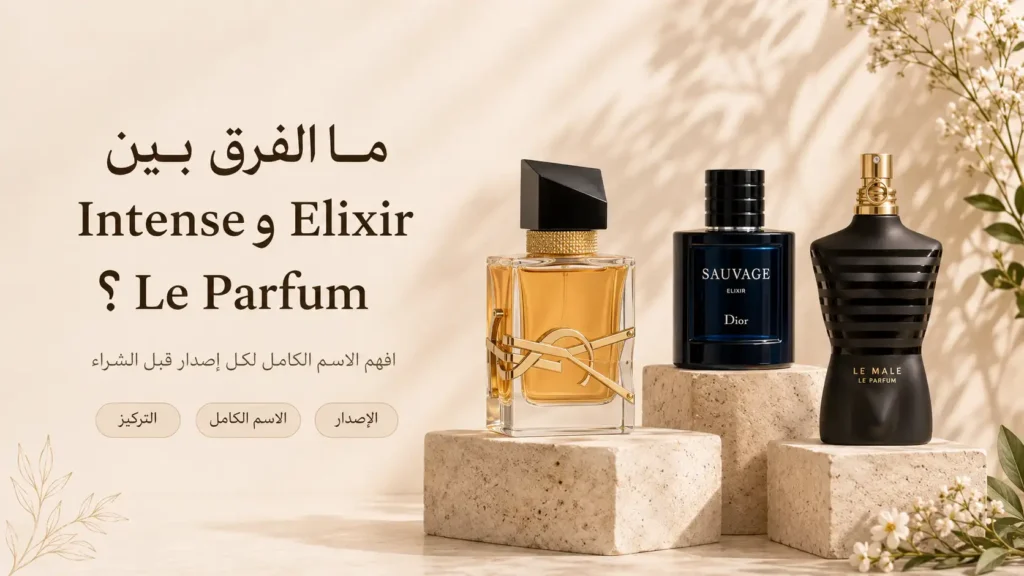
Intense, Elixir and Le Parfum are names each brand chooses to distinguish an edition within a fragrance line. They are not standardized concentration levels across all brands. Dior may register an edition simply as Elixir, BOSS may describe Bottled Elixir as an Eau de Parfum, and YSL may launch a new Le Parfum with a different formula and bottle. The solution is to read the full product name, official concentration and exact edition instead of guessing from the marketing word.
What Does Flanker Mean in Perfume?
A flanker is a new edition linked to an earlier fragrance or line through its name, bottle or concept, but it may change the notes, concentration, colour, audience and overall scent direction. It is not necessarily a stronger version; it may be fresher, sweeter, darker, lighter or a modern reinterpretation.
Why Is There No Single Rule for These Names?
No authority forces every brand to use Intense, Elixir or Le Parfum at one fragrance-oil percentage. The commercial edition name and the concentration written on the bottle are separate pieces of information. Even within one brand, the meaning of a word can vary between product lines.
For example, Azzaro The Most Wanted Eau de Parfum Intense combines the word Intense with the concentration name Eau de Parfum in one edition. That does not mean it is simply a stronger version of every other fragrance in The Most Wanted line.
| Word | What It May Indicate | What You Cannot Assume |
|---|---|---|
| Intense | An edition that redirects the scent or emphasizes a particular facet | That it is always a higher concentration or has better longevity |
| Elixir | A name for an edition positioned as denser or different within a particular line | That it is a standard concentration category or always above Parfum |
| Le Parfum | An edition name that may carry a concentration separately stated by the brand | That it is automatically Parfum or the original formula at a higher percentage |
| Parfum | May be an official concentration or part of the product name | That every title containing Parfum represents the same percentage |
| Absolu / Absolute | A marketing name for a reinterpretation or sometimes a limited edition | That it is a standardized concentration or quality level |
| Extrait | A concentration named by the brand for a specific product | A universal percentage or guaranteed performance on every wearer |
Example 1: Dior Sauvage Elixir
Dior officially names the product Sauvage Elixir and describes it as an extraordinarily concentrated fragrance within the Sauvage line. The official page does not present it as Eau de Parfum. Writing “Sauvage Elixir EDP” in a store title would mix the commercial name with an unsupported concentration and can make the product data inaccurate.
The same identification principle applies to Gucci Guilty Elixir. Elixir is part of the identity of a distinct edition with its own formula and positioning, not a universal concentration tier that can automatically be compared with every EDP or Parfum.
Example 2: BOSS Bottled Elixir
By contrast, official HUGO BOSS pages describe BOSS Bottled Elixir as an Eau de Parfum and position it as the most concentrated BOSS Bottled expression up to that release. This proves that the word Elixir alone does not define concentration; Dior and BOSS use the name within different systems.
Example 3: Y, The New Le Parfum
According to the official YSL page reviewed for this guide, Y, The New Le Parfum is presented with its own visual identity and as “More concentrated,” while Y Eau de Parfum remains a separate product. Sizes and availability can change over time, so match the bottle image, barcode or reference, year and current official page before buying. The name Y Le Parfum alone may not be enough when an older edition and a newer update coexist.
Edition Identity Checklist Before Buying
- Brand.
- Main fragrance line.
- Full edition name: Intense, Elixir, Le Parfum or another designation.
- Officially stated concentration, if any.
- Size.
- Bottle colour and design.
- Launch or update year when similar editions exist.
- Official audience.
- Official page or brand catalogue.
- Whether the product is refillable, a Gift Set or a Tester.
Is the “Stronger” Edition Better Than the Original?
Not necessarily. You may prefer the original because it is fresher or clearer, while a flanker may be sweeter, woodier or less suitable for work. “Stronger” is not the same as “better,” and performance is only one factor. See our guide to reducing blind-buy risk.
Is EDP Better Than EDT?
Not as a rule. An EDT may feel brighter or project more in the opening, while an EDP may be warmer or smoother. The decision depends on the specific product. A change in concentration may come with a reformulated scent structure rather than simply adding more fragrance oil to the same liquid.
How Do You Compare the Original and a Flanker?
| Question | Original | Flanker |
|---|---|---|
| What is the overall direction? | The baseline character of the line | What changed: sweetness, spice, woods, freshness? |
| Is the concentration different? | Read the official bottle or page | Do not infer it from the edition name; read the official bottle or page |
| When does it suit you? | According to scent character and dosage | It may change the use case, but is not automatically evening-only |
| Is performance higher? | Test it | Test it; the name does not guarantee hours or projection |
| Is it the same edition? | Match year and bottle | Match the full name, colour, reference and official page |
Jean Paul Gaultier Le Male Le Parfum is another good example of why Le Parfum should be treated as part of the exact edition name, not proof that the product is merely the original formula at a higher concentration.
Common Store-Listing Mistakes with Flankers
- Automatically writing Elixir EDP when the brand does not state EDP.
- Using Parfum and Eau de Parfum together for one edition when they conflict.
- Using images from an older edition with the description of a newer one.
- Combining sizes from two different editions in one variation product.
- Copying a note pyramid from another flanker with the same base name.
- Claiming that Intense definitely lasts longer than the original.
How to Apply This Comparison in King Store
When browsing men’s perfume, you may see closely related names such as Sauvage Elixir, Y Le Parfum, Fahrenheit Parfum and BOSS Bottled Elixir. Compare the full name, concentration, bottle image and size with the official page for the exact edition, and do not assume that marketing terms form one universal ladder across brands.
Before Checkout: Lock the Edition Identity into One Line
Before adding any flanker to your cart, write its identity in one line: brand + line + edition name + concentration + size. YSL Y Le Parfum 100ml is not simply “Y,” and Gucci Guilty Elixir de Parfum 60ml is not simply “Gucci Guilty.”
This small step prevents reviews, prices and note lists from being mixed across similarly named editions. Once identity is fixed, compare the scent itself instead of assuming Elixir or Intense automatically means a “better” version.
Official Sources
Frequently Asked Questions
Is Elixir always above Parfum?
No. Elixir is a commercial edition name, not a standardized concentration category. Read how the brand identifies the exact product.
Does Intense mean stronger longevity?
Not automatically. It may mean a change in scent direction or notes, and performance must be tested rather than inferred from the name.
Is Le Parfum the same as Parfum?
Not necessarily. It can be an edition name. Check the bottle and official page for the stated concentration.
What is the difference between an original fragrance and a flanker?
A flanker is related to the original but can change the formula, concentration, scent character and bottle. Do not treat it as the same fragrance at a higher percentage.
How do I avoid buying the wrong edition?
Match the full name, concentration, size, bottle colour and year or reference with the official page, then compare the store images.