
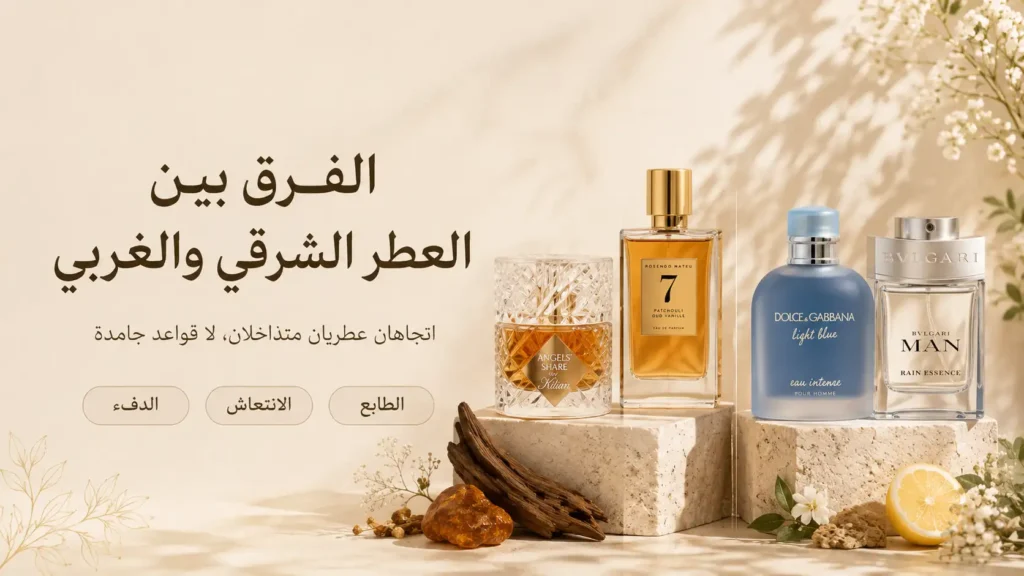
“Eastern perfume” and “Western perfume” are not two opposing scientific categories. Historically, “Oriental” was used for warm families built around amber, vanilla, resins and spices, while commercially “Eastern” may also be used for Arabic or Gulf fragrances. “Western” may refer to the brand’s country rather than the smell. A more precise choice starts with scent character: amber, woody, citrus, floral, leather or gourmand, then the notes and intended use.
Why Is This Division Confusing?
Because one word can describe three different things:
- Origin: the brand’s country or place of manufacture.
- Style: a commercial image associated with sweetness, oud or spice.
- Fragrance family: the historical classification once called Oriental, which modern references increasingly call Ambrée or Amber.
When these levels are mixed together, inaccurate assumptions appear, such as every Arabic brand making heavy perfumes or every European perfume being fresh and light.
What Did “Oriental” Mean in Older Fragrance Classification?
The Perfume Society explains that the historical term covered directions containing amber, sandalwood, vanilla, resins and related materials, and that it replaced the word with Ambrée because the older term is outdated and can be offensive to some people. This change also shows that the term was not a literal description of one authentic “Eastern smell” or one geographical region.
Does an Arabic Perfume Mean an Amber or Oud Perfume?
No. An Arabic house can create a citrus, aquatic or clean floral fragrance, while a European house can produce a dense perfume built around oud, incense and amber. The brand’s country does not determine fragrance family or performance.
Are Western Perfumes Lighter or Higher Quality?
No. Lightness, density and quality depend on the formula, materials, execution and dosage, not automatically on origin. A niche label, high price or country name also does not prove higher quality.
A More Accurate Comparison Than Eastern vs Western
| Instead of Asking | Ask This | What You Learn |
|---|---|---|
| Is the perfume Eastern? | Is it amber, spicy, oud, incense or gourmand? | The type of warmth and depth instead of one broad label |
| Is the perfume Western? | What is its family and what are the main notes? | The actual scent instead of the brand’s country |
| Is it strong? | What level of presence suits the setting and dosage? | Practical use without a performance promise |
| Is it good for summer? | Is the character dense or fresh, and is the place air-conditioned? | A decision suited to Egypt rather than an absolute seasonal rule |
| Is it for men or women? | Do I enjoy the scent character on my skin? | Personal preference instead of stereotypes |
Examples That Break the Binary
Nishane Hacivat X
Nishane is a Turkish house, but Hacivat X is officially described as citrus/chypre/woody, with pineapple, bergamot, lemon and woods. A brand from a country geographically close to what people may call “the East” does not make this an oud or incense perfume.
Bvlgari Man Rain Essence
Bvlgari Man Rain Essence Eau de Parfum 100ml comes from an Italian house and is officially classified by Bvlgari as Fresh Woody Musk. The example does not prove that Western perfumes are fresh; it shows that the official product page and fragrance family matter more than origin.
Kilian Angels’ Share
A French house offers Angels’ Share with a warm character inspired by cognac, oak and tonka. Some people may describe that direction as “Eastern” or “amber” even though the brand is European, which exposes the weakness of a geographical binary.
What About Oud, Amber and Musk?
These terms need context. Oud can refer to a raw material, scent effect or reconstructed accord; amber in perfumery is usually a warm constructed accord rather than a piece of fossilized amber; and modern musk may rely on synthetic molecules. Their presence does not determine the perfume’s geographical origin and does not guarantee strength or quality.
How Do You Choose According to Your Taste?
- Choose two sensory words: fresh, dry, sweet, warm, smoky, green, powdery or creamy.
- Identify notes or accords you tend to avoid.
- Define the place, weather and desired level of presence.
- Compare two fragrances from the same scent direction but from different brands.
- Confirm the full name, concentration and official edition.
- Test on skin when possible before deciding.
Quick Guide to Scent Character
- Citrus and fresh: bergamot, lemon, orange, herbs, tea or aquatic accords.
- Woody and dry: cedar, vetiver, patchouli, modern woods.
- Amber and warm: vanilla, benzoin, labdanum, resins and spices.
- Oud and smoky: oud or oud accords combined with woods, incense and leather.
- Floral and fruity: rose, jasmine, white florals and different fruits.
- Gourmand: accords recalling desserts, coffee, caramel or vanilla.
The Egyptian-Market Reality
Hot weather, transport and air-conditioned offices make dosage and setting more important than the brand’s country. A warm amber fragrance can work at a limited dose in an air-conditioned place, while a fresh fragrance can become uncomfortable if overapplied. Do not turn “Eastern for winter, Western for summer” into a rule.
A Better Way to Browse King Store Than “Eastern vs Western”
If the goal is to choose a fragrance, use four simpler axes than the brand’s country: fresh or warm, sweet or dry, lighter or denser in character, and whether you want noticeable oud, incense or spice. A European house can produce a dense amber fragrance, while a Middle Eastern house can produce a fresh one, so origin should not lock you into one scent expectation.
At the fresher end, Bvlgari Man Rain Essence offers a green, watery and woody-musky profile. If your real question is about oud, amber or musk, use the oud vs amber vs musk guide rather than using “Eastern” as a shortcut for several different scent directions.
Trusted Sources
- The Perfume Society: transition from Oriental to Ambrée
- Nishane: official Hacivat X description
- Bvlgari: official classification of Man Rain Essence
- Kilian Paris: Angels’ Share
Frequently Asked Questions
Does “Eastern perfume” mean Arabic perfume?
Not always. The term may refer to a historical amber family, a commercial style or geographical origin, so the intended meaning needs to be clarified.
Do all Arabic perfumes contain oud?
No. They can be citrus, floral, aquatic, woody or gourmand, just like fragrances from any other market.
Are Western perfumes lighter?
No. There are dense, warm European fragrances and fresh, light Arabic fragrances. Formula matters more than country.
What is a more precise alternative to “Eastern”?
Use descriptions such as warm amber, spicy, oud, incense or gourmand according to the actual smell.
How should I choose for Egypt’s climate?
Define the setting, temperature and air conditioning, then adjust dosage. Do not make origin or season an absolute rule.