
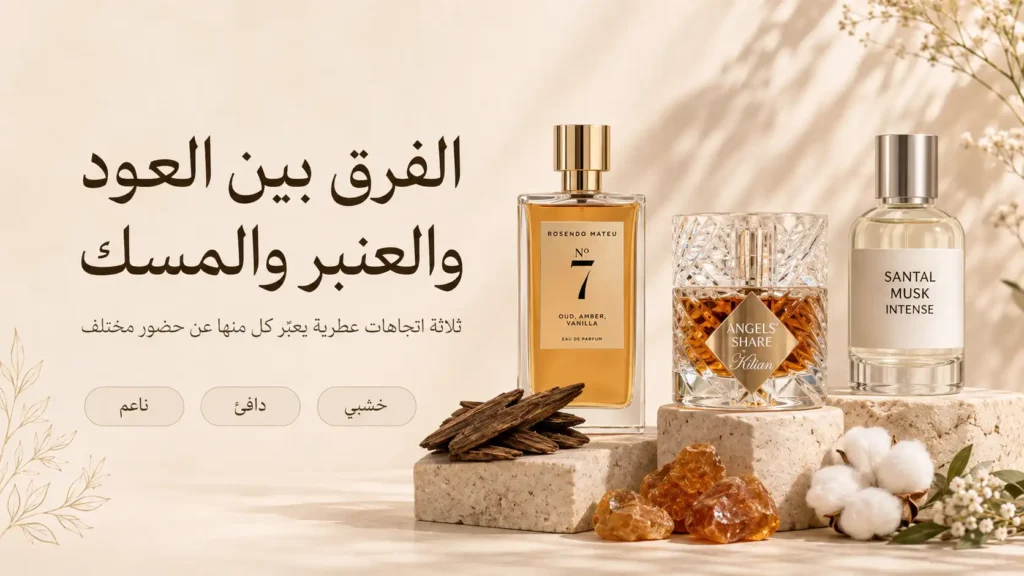
Oud, amber and musk are not three similar names for one type of smell. Oud is a woody direction that can feel warm, smoky or leathery; amber in perfumery is usually a constructed warm accord rather than a piece of fossilized amber; and modern musk covers a wide spectrum from clean and powdery to warm and leathery. Most importantly, seeing one of these names in a note list does not by itself prove that the product contains one specific natural material.
Start with the Difference Between a Raw Material, a Note and an Accord
Much of the confusion comes from using the same word in more than one way, so understanding the difference between a raw material, a fragrance note and an accord helps you read descriptions accurately. When you see “oud,” “amber” or “musk” on a product page, the brand may mean a natural material, a synthetic material or a group of materials designed to create one particular scent impression.
| Term | What It Means | What It Does Not Prove |
|---|---|---|
| Raw material | An actual natural or synthetic material used in the formula. | A note name does not always reveal it, and product pages usually do not publish the complete formula. |
| Fragrance note | Descriptive language for what the perfumer wants you to imagine or perceive. | It is not a chemical ingredient list or proof of a natural source. |
| Fragrance accord | A blend of materials that creates one complete impression such as leather, amber or sea breeze. | It does not have to come from one material carrying the same name. |
This is why two perfumes may both list “musk” while one smells clean and transparent and the other warm and animalic. A perfume may list “amber” without containing ambergris, and an oud effect can be reconstructed with several materials rather than natural oud oil.
What Is Oud in Perfume?
Natural oud is associated with resinous wood formed in certain Aquilaria and Gyrinops trees. International trade in oud-producing species is regulated under CITES because sourcing, sustainability and traceability are important issues for this high-value material.
But the word Oud or Aoud in a perfume name does not automatically mean the bottle contains a defined amount of natural oud oil. A perfumer may use natural oil, a combination of natural and synthetic materials, or an accord that reconstructs the impression. You cannot determine this from the marketing name alone.
What Can Oud Smell Like?
- Dry woody or resinous.
- Smoky, leathery or earthy.
- Medicinal or mineral in some compositions.
- Smooth and polished when blended with rose, vanilla or creamy woods.
There is no single smell for all oud. Material type, origin, distillation method, dosage and surrounding materials change the result. Do not describe every perfume containing the word Oud as heavy or smoky before reading the full description and testing it.
One example available at King Store is Montale Black Aoud Eau de Parfum 100ml. Montale officially describes the composition with Cambodian oud, patchouli, rose, musk and mandarin. This shows that oud here is part of a rosy, woody-musky construction rather than one isolated smell.
What Does Amber Mean in Perfume?
The word “amber” in a perfume description needs context because it can refer to different things:
- Amber accord: a warm accord that often creates a resinous, vanilla-like or balsamic impression and may use materials such as labdanum, benzoin, vanilla, spices and woods.
- Ambergris: a different material historically associated with the sperm whale, with a distinct legal, ethical and sourcing context.
- Fossilized amber: the decorative stone, which is not the usual source of the “amber” smell in modern perfume.
Do not automatically translate Amber as whale ambergris or assume the word means an animal-derived ingredient. In most contemporary fragrance descriptions it is closer to a constructed warm scent character.
What Can an Amber Character Smell Like?
- Warm, resinous or balsamic.
- Sweet or vanilla-like, but not necessarily gourmand.
- Spicy, incense-like or woody.
- Soft and enveloping or drier depending on the formula.
Sospiro Basso Eau de Parfum 100ml lists amber in a base that also includes patchouli, vetiver and oakmoss. It is a useful example of why the word amber alone does not tell you the final character: it works inside a broader citrus, woody and chypre structure.
What Is Musk in Modern Perfumery?
Historically, natural musk was associated with the musk deer, but IFRA asked fragrance manufacturers to stop using natural musk from 2000 in light of species protection and CITES regulation. Modern perfumery therefore relies on broad families of synthetic musks, and more than one type may be used within the same composition.
Terms such as “white musk” or “Crystal Musk” do not necessarily identify one particular plant or animal material. They are often descriptions of a clean, transparent or soft effect, while other musks may smell powdery, warm, leathery or skin-like.
What Can Musk Smell Like?
- Clean, like freshly washed fabric.
- Transparent, soft and close to the skin.
- Powdery or creamy.
- Warm, leathery or animalic in some formulas.
Bvlgari officially describes Man Rain Essence Eau de Parfum 100ml as Fresh Woody Musk and mentions a Crystal Musk accord in the heart. This shows how musk can be transparent and fresh inside a woody fragrance, not necessarily heavy or “Eastern”.
Sensory Comparison: Oud vs Amber vs Musk
| Term | Possible Character | Common Pairings | Best Question Before Choosing |
|---|---|---|---|
| Oud | Woody, resinous, smoky, leathery, earthy or polished. | Rose, saffron, leather, vanilla, patchouli, woods. | Is the oud clear and smoky, or soft and blended with sweetness or florals? |
| Amber | Warm, balsamic, resinous, vanilla-like, spicy or incense-like. | Vanilla, benzoin, labdanum, spice, woods, florals. | Does “amber” mean a warm amber accord or ambergris, and what surrounds it? |
| Musk | Clean, powdery, creamy, warm, leathery or skin-like. | Florals, woods, citrus, amber, vanilla. | Is the musk transparent and clean or warm and animalic? |
This table helps create an initial expectation, but it does not replace testing. The complete formula determines the result, not one word on its own.
How Can These Directions Blend Together?
Oud, amber and musk can appear in the same fragrance, with each playing a different role depending on the formula:
- Rose and oud can create contrast between floral and woody character.
- Amber can add resinous warmth or balsamic sweetness around the woods.
- Musk can soften edges, create a clean effect or bring the scent closer to skin.
- Vanilla, spice and leather can completely change how all three are perceived.
Nishane Nefs, for example, officially lists amber and oud within a base that also includes whisky, cinnamon, cedar, leather and vanilla. It cannot be reduced to the word “oud”; it is a layered floral, gourmand and musky composition.
Do Oud, Amber or Musk Guarantee Stronger Longevity?
No. Some materials used to construct these directions may persist for a long time, but a note name does not tell you its proportion, type or concentration and does not reveal the complete formula. Performance also varies with dosage, skin, weather, clothing and setting.
Avoid rules such as:
- Every oud perfume is strong and long-lasting.
- Every amber perfume is only for winter.
- Musk automatically makes every perfume last longer.
- Natural materials are automatically better or safer than synthetic ones.
- Seeing the name proves the presence of an expensive natural material.
How Do You Choose Between Oud, Amber and Musk?
- Start with the feeling you want: dark woody, warm balsamic, or clean and close to skin?
- Read the complete description: do not stop at the main note; check the surrounding florals, sweetness, spice and woods.
- Check the official source: does the brand publish an ordered note structure or only a broad direction?
- Do not infer the raw material: Oud or Musk in the name does not prove a natural or animal source.
- Test on skin: especially dark oud, animalic musks and sweet amber styles, which can divide opinion.
- Choose for the setting: a crowded office needs more control than an open-air occasion regardless of fragrance family.
Compare Oud, Amber and Musk Through Real King Store Examples
Instead of imagining each word in isolation, use products as examples of different directions. Montale Black Aoud helps illustrate a more obvious oud direction, while Sospiro Basso places the idea in a different, more complex composition, and Bvlgari Man Rain Essence shows how musk can sit inside a fresh structure rather than always feeling dense.
Use these as directional examples, not as proof that every oud or musk fragrance will smell similar. The note name is only a starting point; the full construction determines the experience.
Verification Sources
- CITES: medicinal/aromatic plants and oud-producing species.
- IFRA Regulatory FAQ: natural musk and species protection.
- IFRA: how fragrances are made from natural and synthetic materials.
- Montale Black Aoud — official page.
- Sospiro Basso — official page.
- Bvlgari Man Rain Essence — official page.
- Nishane Nefs — official page.
Frequently Asked Questions
Does amber in perfume mean ambergris?
Usually not. Amber in fragrance often means a constructed warm accord, while ambergris is a different material. Check the brand description instead of assuming the meaning.
Does modern musk come from musk deer?
Modern perfumery relies on varied synthetic musks, and IFRA asked manufacturers to stop using natural musk from 2000. The word “musk” on a product page does not prove an animal source.
Does every oud perfume contain natural oud?
You cannot determine that from the name. A formula may use natural material, a natural/synthetic blend or an accord that reconstructs an oud effect.
Which is heavier: oud, amber or musk?
There is no fixed answer because each term covers a wide range. Musk can be extremely transparent, oud can be soft, and amber can be dry rather than sweet depending on the formula.
Do these notes increase longevity?
The name alone is not enough to predict performance. Material type, proportions, the rest of the formula, concentration, climate and skin all matter.