
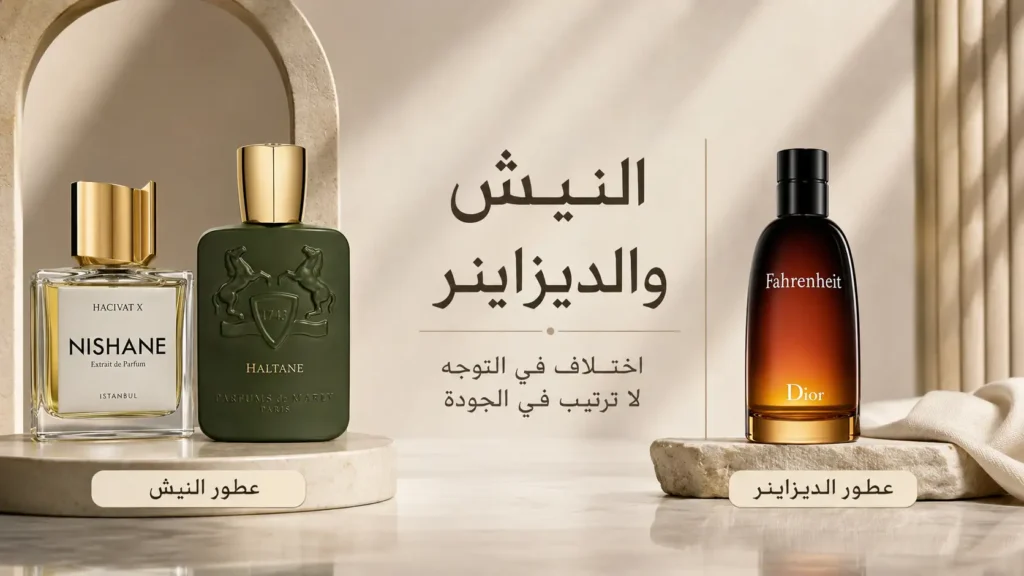
Niche perfumes are usually associated with houses that make fragrance central to their identity and often focus on a specific creative vision or olfactory style rather than trying to appeal to the broadest possible audience. But the word “niche” is not an automatic certificate of higher quality or stronger longevity, and the boundary between niche and designer fragrances has become less clear. The better decision is to compare the scent, exact edition and real wearing experience instead of buying the label alone.
What Does Niche Perfume Mean?
“Niche” means specialized or aimed at a narrower segment. In fragrance, the term was historically used for houses with limited presence in general retail, selling through their own stores or specialized points of sale and building their core identity around perfume.
Specialist houses such as Nishane illustrate this fragrance-centered model. A perfume such as Hacivat is better judged by its scent character, concentration and actual use than by the word niche alone.
Perfume.org explains that the classification was historically connected to how many retail outlets carried a fragrance: widely distributed perfumes in major stores were considered mainstream or designer, while smaller houses and selective distribution became associated with niche. The Perfume Society describes niche fragrances as often more unusual, individual or harder to find, while still using the same broad palette of fragrance materials available to the wider industry.
Today, no single rule is enough to decide the category. A small independent house may grow into a global brand, or be acquired by a larger group while keeping its fragrance identity. A fashion house may also launch a selective exclusive collection. It is more accurate to look at several signals instead of one label.
What Are Designer Perfumes?
Designer perfumes are usually fragrances released by fashion houses or brands that also operate in clothing, bags, watches, cosmetics or other categories. Fragrance is part of a broader brand portfolio and often benefits from wider distribution, advertising and retail reach.
This does not mean designer fragrance is less creative or uses simpler formulas. Many designer scents are created by well-known perfumers and produced by major fragrance houses that also work with niche brands. The main difference is usually the brand model, market, distribution and purpose of the release—not “good ingredients” in one category and “bad ingredients” in the other.
Niche vs Designer Perfumes
| Comparison | Niche Often | Designer Often | What You Cannot Generalize |
|---|---|---|---|
| Brand identity | Perfume is the main activity or the most visible part of the identity | Perfume is part of a fashion house or multi-category brand | Hybrid houses and exclusive fragrance collections exist inside designer brands |
| Distribution | Selective through specialist retailers or limited channels | Broader through department stores, travel retail and general retail | Some niche houses are now widely distributed worldwide |
| Creative direction | A specialist identity may allow less conventional ideas or structures | A release may consider a broader audience and ease of wear | Boldness is not exclusive to niche, and accessibility is not a flaw |
| Number of releases | The collection may be smaller and more focused on the house story | May include large lines and many flankers | Some niche houses release frequently while some designer brands are selective |
| Price | May rise because of smaller scale, distribution, packaging or positioning | Ranges from mainstream prices to expensive private collections | Price does not prove ingredient quality or suitability for you |
| Longevity and projection | Vary from perfume to perfume | Vary from perfume to perfume | Performance cannot be inferred from niche or designer classification |
Why Has the Niche vs Designer Boundary Become Blurred?
Limited distribution and independence were once common signals of niche, but the market has changed. Some houses that began independently are now available in many countries and retailers, and some have joined major beauty groups while continuing to be presented as niche. At the same time, designer houses may offer exclusive collections, selective distribution and fragrance experiences that do not target the mass market.
Enthusiasts may therefore disagree about how to classify a specific brand. That debate should not distract from the real buying questions: do you enjoy the fragrance, does its presence suit you, and does the experience feel worth the price and risk?
What Does the Word “Niche” Not Guarantee?
- It does not guarantee more natural materials: every fragrance category can use natural and synthetic materials according to the formula.
- It does not guarantee higher quality: quality needs a defined standard and cannot be proved by brand category alone.
- It does not guarantee stronger longevity or projection: performance depends on construction, materials, weather, skin and application.
- It does not guarantee rarity: a niche perfume can become famous and widely available.
- It does not guarantee that it suits your taste: a more unusual scent is not automatically better for someone who wants easy daily wear.
- It does not guarantee value for money: part of the price may come from distribution, packaging, identity, marketing and production scale.
Why Can Niche Perfumes Be More Expensive?
There is no single reason that applies to every bottle. Price may reflect formula development, production scale, packaging, selective distribution, specialist retailer margins and market positioning. Some fragrances may use costly materials or special production processes, but that should not be assumed for every product described as niche.
The final retail price is not the cost of the liquid alone. Bottle, box, design, shipping, marketing and brand identity are all part of the commercial product. Compare what matters to you: the scent, wearing experience, bottle size and how often you expect to wear it, rather than treating price as a standalone proof of superiority.
Are Niche Perfumes Stronger or More Long-Lasting?
Not necessarily. Niche includes quiet fragrances that stay close to the skin and others with very noticeable diffusion, just as designer fragrance does. An Extrait or Eau de Parfum label also does not become a universal promise of a fixed number of hours.
A niche perfume may be designed to express one material or idea in a subtle, intimate way, while a designer perfume may project more strongly. Choose based on the real performance of the exact edition under your own wearing conditions, not the category name.
Examples That Explain the Difference Without a “Best” Ranking
Parfums de Marly Haltane
The official Haltane page describes a structure combining bergamot and pink pepper, then saffron, praline and lavender, leading to oud, patchouli, vetiver and leather. The example is useful for understanding how a fragrance house builds a clear identity around a story and composition. It does not prove that every niche perfume must contain oud or be powerful.
You can review Parfums de Marly Haltane Eau de Parfum 125ml as one example of a specialist perfume-house identity, while evaluating the product itself rather than assuming fixed characteristics for every niche fragrance.
Ramon Monegal Flamenco
Ramon Monegal describes Flamenco as an olfactory expression of flamenco art, with raspberry, violet and orris, followed by jasmine, rose and rosewood, and a base of musk and woods. This shows the personal storytelling and artistic-vision angle often associated with the niche world.
You can review Ramon Monegal Flamenco Eau de Parfum 100ml as an example different from Haltane, without assuming that one is higher quality or that both suit the same audience.
Dior Fahrenheit Eau de Toilette
By contrast, Dior Fahrenheit Eau de Toilette 100ml is a designer fragrance from a global fashion house, yet it has a highly recognizable identity and a distinctive scent direction. This is why the comparison should not be reduced to “niche is creative and designer is ordinary.”
Who Might Enjoy Niche Perfumes?
Niche may suit you if you enjoy exploring less familiar scent styles, want to understand the vision of a house or perfumer, or are looking beyond widely distributed lines. More Than Words is a useful example of this side of niche fragrance: it belongs to Xerjoff’s Join The Club collection and is linked to a literary concept about writers and poets rather than relying only on a traditional note pyramid. You do not need to be an expert; you simply need to start with your sensory preferences instead of buying whatever is described as more luxurious.
Designer fragrance may be the smarter choice when you want something easier to test and more widely available, already know a line you enjoy, or need straightforward daily wear without taking a large risk. There is no prize for choosing the more difficult category.
Is Niche Perfume Suitable for a Blind Buy?
The risk may be higher when the scent is unfamiliar, the price is high or the note description is far from what you already know. Reading the notes does not reproduce the full scent, and other people’s reviews do not guarantee your own reaction.
The Perfume Society recommends trying fragrance on paper first to reduce the options, then on skin and following its development before buying a full bottle. If a sample is unavailable, look for an in-store test or choose something close to fragrances you already understand rather than jumping into a full bottle because the name is famous.
Also review the exchange and return policy before ordering. It defines eligible products, exclusions and required procedures. Check the current version at the time of purchase before opening or using the product.
Practical Roadmap Before Buying Your First Niche Perfume
- Write down three perfumes you enjoy: identify shared families or scent directions, not just brand names.
- Choose one goal: daily wear, an occasion, a gift or a more artistic experience.
- Build a shortlist: compare only two or three options so descriptions do not blur together.
- Confirm the edition: full name, concentration, size and official audience, especially with flankers.
- Read the official description: use it to confirm identity and notes rather than relying on a competitor’s copy.
- Test on skin when possible: give the fragrance enough time to move beyond the opening.
- Judge value after testing: ask how often you will wear it, not how rare or luxurious it looks online.
How to Use the Niche Perfumes Category at King Store
You can start with the Niche Perfumes category to compare available products by full name, concentration, size and scent direction, then return to each product page to confirm the exact edition and description when you are ready to choose.
Start with your taste, then compare the exact edition and test it as much as possible. When the fragrance suits you and you know you will wear it, the classification becomes useful context—not the only reason to buy.
Official and Reference Sources
- Perfume.org: historical niche vs designer distinction
- The Perfume Society: niche fragrance and testing guidance
- Parfums de Marly Haltane — official page
- Ramon Monegal Flamenco — official page
- Dior Fahrenheit Eau de Toilette — official page
Frequently Asked Questions
Are niche perfumes higher quality than designer perfumes?
You cannot generalize that. Excellent and average fragrances exist in both categories, and quality standards differ between people. Compare the product itself, its source, formula and your experience instead of relying on the classification.
Are niche perfumes stronger and longer-lasting?
Not necessarily. Longevity and projection depend on construction, materials, climate, skin and application. Some niche fragrances are quiet, some designer fragrances are powerful, and the reverse is also true.
Why are niche perfumes expensive?
Price may include production scale, development, packaging, selective distribution and brand positioning, and some releases may use costly materials. Price alone does not prove higher quality or rarer materials.
Can a widely distributed brand still be niche?
It may still be marketed and perceived as niche despite broader distribution or ownership changes, which is why the boundary has become blurred. It is better to assess the house identity, working model and distribution instead of searching for one absolute rule.
Is niche perfume suitable as a gift or blind buy?
It can be, but risk is higher when you do not know the person’s taste or the scent is unfamiliar. It is better to choose something the recipient already knows, test a sample, or build a shortlist from previous preferences before buying a full bottle.
How to Choose a First Niche Fragrance from King Store
Start from the niche perfume category and build a shortlist by scent direction rather than price or house prestige. Parfums de Marly Haltane and Ramon Monegal Flamenco, for example, do not represent one “niche smell”; their different scent directions matter more than the shared label.
If you are unfamiliar with that style, do not let price or the word “niche” become the reason to buy. Compare the scent description with fragrances you already know you enjoy, then reduce blind-buy risk before committing to a full bottle.